Showing posts with label foods. Show all posts

Tuesday, 2 September 2014

Quaker Oatmeal cookies Chocolate Chip Nutrition Facts (Nutritional Information)

Quaker Oatmeal cookies Chocolate Chip Nutrition Facts (Nutritional Information). Quaker Oatmeal, it be cereals or in the form of cookies have been the popular choice of the many, specially the diet conscious individuals. Over time, the manufacturer of this product came up with a variety of flavors in its cookies denominations, hence the "Chocolate Chip" we got in the feature today.

Quaker Oatmeal cookies Chocolate Chip Nutrition Facts

Quaker Oatmeal cookies Chocolate Chip Nutrition Facts:

Quaker Oatmeal cookies Chocolate Chip Nutrition Facts

If you would like to understand what has been written at the back of Quaker Oatmeal cookies Chocolate Chip we posted above, we got here a previous post, titled "Understanding and Using the Nutrition Facts Label (INFOGRAPHIC)".

Saturday, 21 June 2014

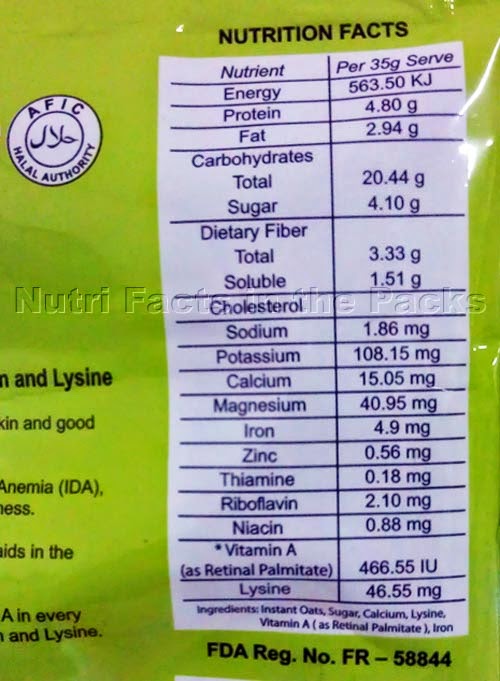
Golden Oats Plus - Vitamin A With Iron and Lysine: Banana Flavor

Golden Oats Plus - Vitamin A With Iron and Lysine: Banana Flavor. This oatmeal snack is available in almost every convenience and retail stores in the Philippines. We got a hold of one pack today for tasting; It was not bad. But if you love sweet-tasting oatmeal snacks, this one comes plain.


Nutrition Facts of Golden Oats Plus - Vitamin A With Iron and Lysine: Banana Flavor. Here is the information that you can find at the back of the pack. Take a look at the Nutrients, Energy, Protein, Fat, Carbohydrates and Dietary Fiber contents, among many others.


Golden Oats Plus Banana Flavor is Halal certified. It is imported / manufactured by Golden Nutritious Foods Corporation, located at RSTI Compound, KM 16, National Road, Pamplona 1740 Las Pinas.


Golden Nutritious Foods 'Nutrition Made Simple' contact information: Tel. No. 872-4348 / Web: www.goldenoatsplus.com

Thursday, 15 May 2014

3 Major Elements You Should Watch Out in a Nutrition Facts Label

In your quest for a healthier eating lifestyle, being conscious and making sure you read the nutrition facts label of every product you are about to consume maybe insufficient.

Nutrition facts label reading

In an article written by ANNEVA CAMPBELL HACKLEY (CHHC) on Shelter Island Reporter, it was noted that at least a consumer should be aware about these three major things:

1. Fat
2. Sodium and;
3. Sugar

Increased consumption of the above-mentioned ingredients can lead a person to serious health risks.

FAT: To break it down a little bit, fats, as what is generally known comprise 20 to 30 percent of any total of calories. While at that, a consumer must be watchful of any possible trans fats contents. Trans fats are hydrogenated and partially hydrogenated oils, and are known to increase blood cholesterol. Eventually, it may trigger heart ailments.

SODIUM: According to the U.S. Department of Agriculture (USDA), the healthy amount of sodium (Sodium Chloride for salt) is between:

1,500mg and 2,400mg per day or 2300mg = 1 teaspoon

SUGAR: The American Heart Association (AHA) recommends the following for a person's daily sugar intake:

Adult women = 20 grams (5 teaspoons)
Men = 36 grams (9 teaspoons)
Children = 12 grams (3 teaspoons)

One should also take note of the presence of high fructose corn syrup (HFCS), as they can raise one's susceptibility of having a heart disease. This and artificial sweeteners are to be avoided, said AHA.

Those are just some of the basic things that you should put into a priority list while consuming commercial products, packed and bottled alike.

Take some time to read every nutrition facts label so that you will become a well-informed consumer.

Image: blog.foodnetwork.com

Monday, 12 May 2014

A Quick Guide to %DV or Percent Daily Value

Some of us could be unmindful what we take in a day to day basis, so much so, the amount of supposed percent of fats and other nutrients that can be found, at least in every packed product we have around.

For a quick reference, the general rule and guide according to FDA is:

5% DV or less is low and 20% DV or more is high

Referring to all nutrients, it is safe to stand on the point that '5%DV or less is low'. This may include the nutrients that we would want to limit intake, such as fat, saturated fat, cholesterol, and sodium among others and those that we want to have in greater amounts like fiber and calcium.

The percent daily value quick guide below shows that a '20% DV or more is high' (all nutrients). If we take a look at the 'Total Fat' label on top of the list, the 18% mark is not yet high, at least for one serving. But if we double things up, say we take two packages of the same food or product, our total fat consumption would become 36%. Obviously, it goes out of the allowable daily percent range.

Quick guide to percent daily value

total fat allowance daily

total fat daily allowance

So what does 36% mean in the real sense? Simply, it leaves you 64% of fat intake from other kinds of foods for the day, and that includes snacks and drinks.

So now perhaps, balanced diet comes into mind, right?

The next time you consume that thing up, take some time to see what's written in the back label.

Might as well, visit this previous post on Understanding and Using the Nutrition Facts Label for another great reference.